Dr. Brad Muller
Applied Meteorology
Embry-Riddle Aeronautical University
Ocean currents: Wind driven (Ekman
Transport) and causes of the North Pacific Gyre
Ocean currents: Thermohaline circulations and climate fluctuations
El Nino/Southern Oscillation (ENSO) and La Nina
Background Info:
Physics of wind:
Meteorology (or at least the branch called "atmospheric dynamics" is Newton's Second Law (F = ma, i.e. Force = mass x acceleration) applied to the atmosphere.
From physics, acceleration is just the time rate of change of velocity, so
We can solve Newton's Second Law for the acceleration by
dividing both sides of F = ma
by m, and rearranging,

then substitute
for the acceleration:

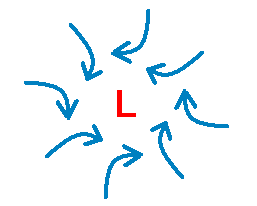
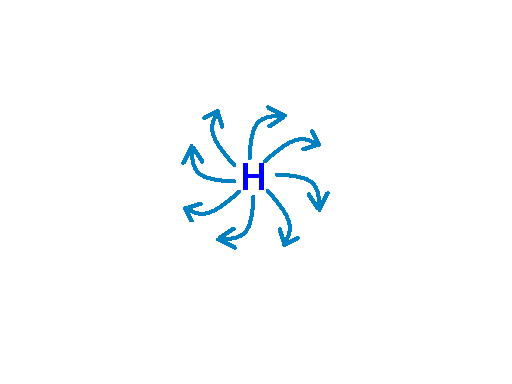
In the northern hemisphere, the Coriolis force makes wind deviate to the right of its forward motion, in the southern hemisphere, to the left. This causes the rotation around low pressure centers and high pressure centers:
1. Ocean currents: Wind driven currents (Ekman transport) and causes of the North Pacific Gyre
North Pacific Gyre
Ocean currents: Thermohaline circulations and climate fluctuations
El Nino/Southern Oscillation (ENSO) and La Nina
Background Info:
Physics of wind:
Meteorology (or at least the branch called "atmospheric dynamics" is Newton's Second Law (F = ma, i.e. Force = mass x acceleration) applied to the atmosphere.
From physics, acceleration is just the time rate of change of velocity, so
then substitute
for the acceleration:
Applied to the atmosphere,
this says that the acceleration of the wind velocity (delta V over
delta t) is a result of the net forces acting on the air:





Coriolis Force--apparent
force due to wind trying to
go in a straight line but the earth is turning underneath it.
Coriolis on a
merry-go-round.In the northern hemisphere, the Coriolis force makes wind deviate to the right of its forward motion, in the southern hemisphere, to the left. This causes the rotation around low pressure centers and high pressure centers:
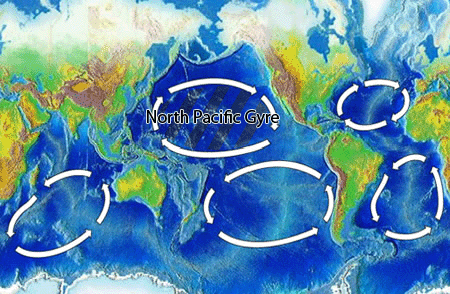
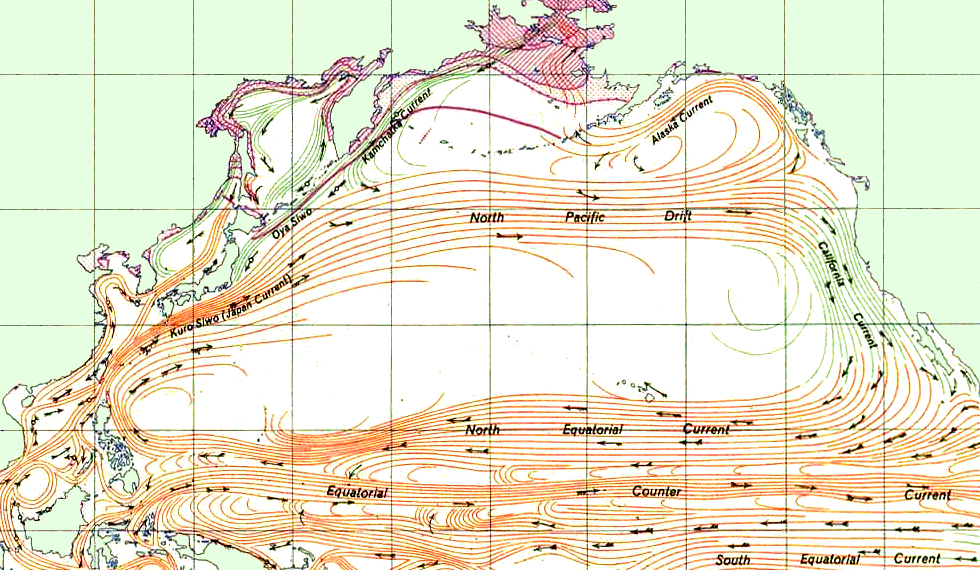
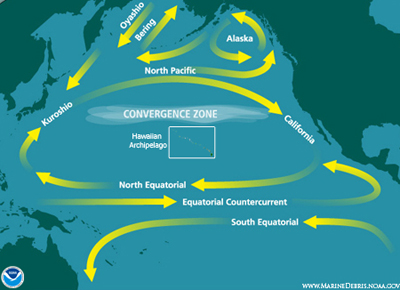
1. Ocean currents: Wind driven currents (Ekman transport) and causes of the North Pacific Gyre
North Pacific Gyre
North Pacific Convergence Zone
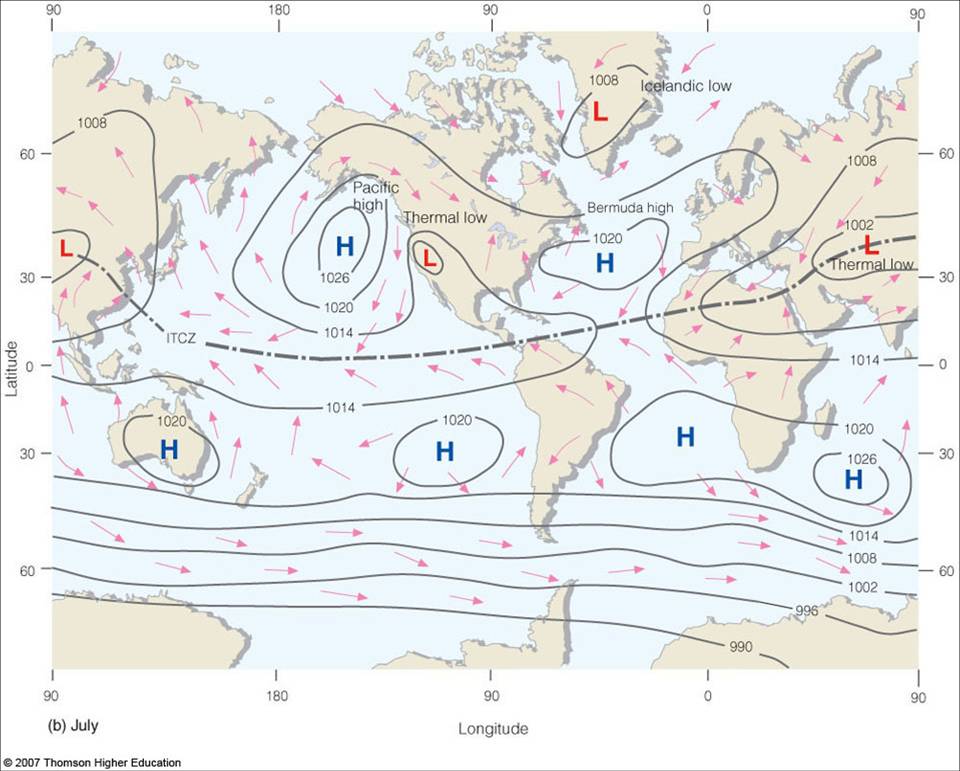
Pacific High Pressure Area
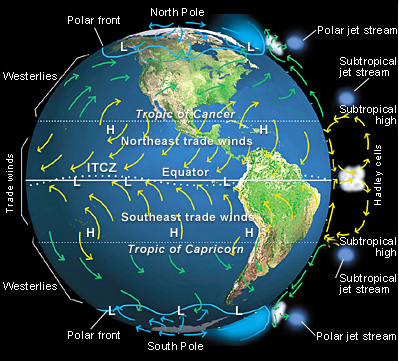
General Circulation of the Atmosphere
Ekman transport/Ekman Spiral
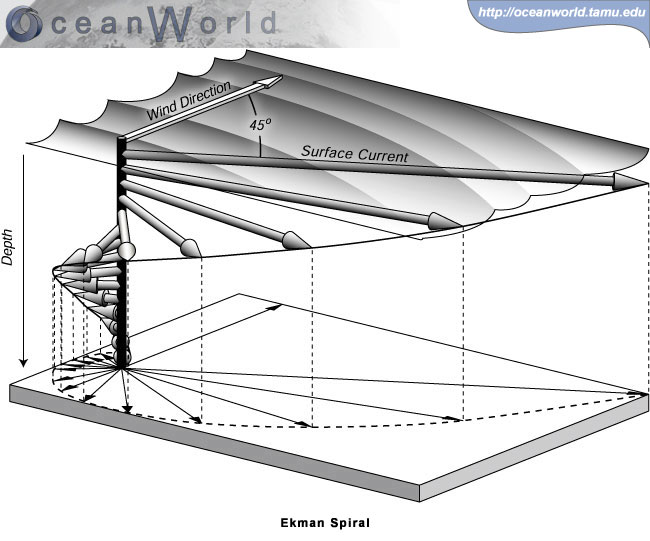
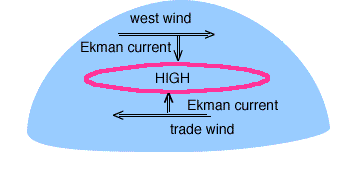
http://oceanworld.tamu.edu/students/currents/currents3.htm
2. Ocean currents: Thermohaline circulations and climate fluctuations
Density of sea water affected by salinity and temperature.
Density differences generate the thermohaline circulation.
The global ocean conveyor belt circulation.
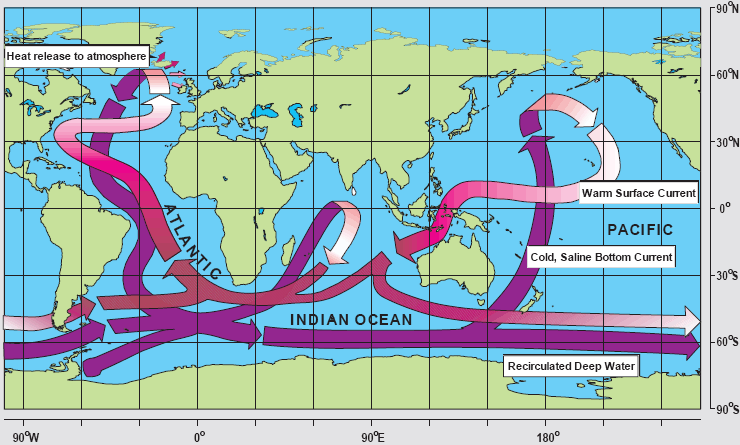
Melting ice may stop the global ocean conveyor belt.
Ironically, this means that lgobal warming could lead to cooling around the North Atlantic and northern Europe.
3. El Nino/Southern Oscillation (ENSO) and La Nina
http://oceanworld.tamu.edu/resources/oceanography-book/equatorialcurrents.htm
http://www-das.uwyo.edu/~geerts/cwx/notes/chap12/trade_enso.html