Wx 354 HW 9 Solutions
a. Numerically
forecast  assuming
 .
.
 =
600 s.
=
600 s.


 .
At t = 10 min,
.
At t = 10 min,  so
it appears to be increasing. At t =
20 min, however,
so
it appears to be increasing. At t =
20 min, however,  ,
a decrease from t
= 0. So one sequence is increasing and
the alternate one decreasing, therefore the solutions at these time
steps are
diverging.
,
a decrease from t
= 0. So one sequence is increasing and
the alternate one decreasing, therefore the solutions at these time
steps are
diverging.
 ,
the maximum time steps for the given wind speeds are
,
the maximum time steps for the given wind speeds are
b. U = 2 m/s 
c. U = 5 m/s 
d. U = 10 m/s 
e. U = 15 m/s 
f. U = 20 m/s 
g. U = 50 m/s 
h. U = 100 m/s 
As the winds speeds
increase,
the maximum allowable time-step decreases to prevent air parcels from
advecting
into a neighboring grid-cell during that
time step.
3. N3 Use eq. 14.7
but
substituting pressure for height:


a. surface weather
station: 

b. ship
observation: 

c. Southern
Hemisphere manual
analysis: 

Discussion:
Observations with
smaller errors, that is, those which are more accurate such as a
conventional
surface weather station, get more weight in the analysis than the first
guess
field; observations with greater expected error, like the Southern
hemisphere
manual analysis get less weight than the first guess field in the
analysis.
4. N4
|
Estimated Forecast Limit in
Days (From Fig. 4.7) |
|
|
Phenomenon |
Limit (days) |
|
a. tornadoes |
minutes |
|
b. hurricanes |
1-2 |
|
c. fronts |
0.5-1.5 |
|
d. cyclones |
3-5 |
|
e. Rossby waves |
6-10 |
|
f. thunderstorms |
< 1 hr |
|
g. |
1-3 hrs |
|
h. lenticular clouds |
minutes-hours |
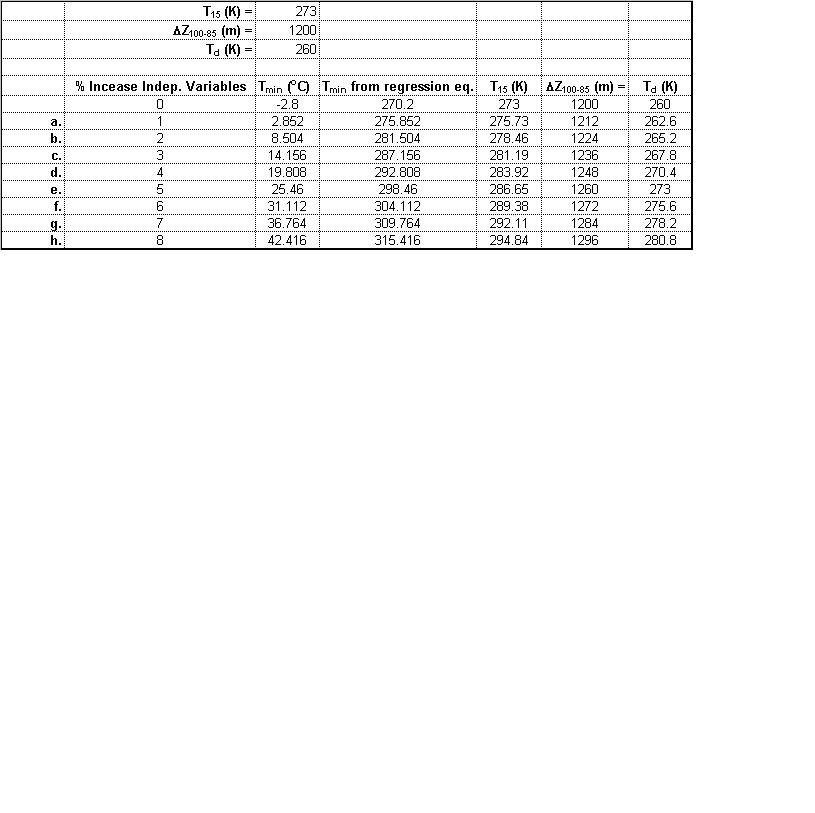
5. N5 Use the regression
equation from the solved example on p. 324:


I used a
spreadsheet to make
the calculations: