RADAR EQUATION
RADAR is an acronym that stands for "RAdio Detection And Ranging." This is an active remote sensing technique because it involves a transmitter sending out pulses of electromagnetic radiation, then measuring the amount of power reflected (scattered) back to the radar antenna. This process can be quantified in the Radar Equation.
The Radar Equation is given as follows:
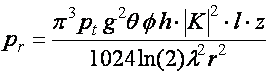
where
pt= power transmitted by radar (watts)
pr= power received back by radar
(watts)
g = gain of the antenna (ratio of power on the
beam axis to power from an isotropic [i.e., radiating equally in all
directions] antenna at the same point); it is a measure of how focused
the radar beam is.
q = horizontal beamwidth
(radians)
f = vertical beamwidth
(radians)
h = pulselength (m)
|K|2 =
dielectric constant for hydrometeors; usually taken as 0.93 for liquid water,
0.197 for ice
l =
loss factor for attenuation of radar beam, varies between 0 and 1, usually near
1. Since the attenuation of the beam is often unknown, it is often ignored.
l = wavelength of radar pulse (m)
r = range or distance to the target (i.e., the
distance to an area of precipitation that reflects the originally transmitted
pulse back to the radar).
z = radar reflectivity factor
(mm6/m3) and can be expressed as

where D is the drop diameter and the summation is over the
total number of drops (of varying sizes)
within a unit volume within the beam;
in the equation it gets multiplied by the radar volume [defined by the beam
width, height, pulse length and distance from the radar]
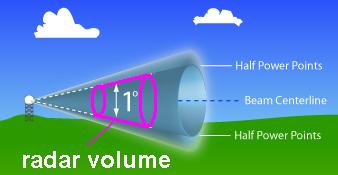
Therefore z is a function of
the diameters and number of drops in unit volume, i.e., the drop size distribution.
Note that z is an inherent property of
the drop size distribution sampled and is not radar dependent.
However, the drop size
distribution in the measured volume is unknown. Therefore, we calculate the
radar reflectivity factor, z, from the return power, pr, by solving
the above equation for z:
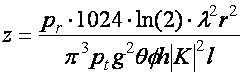
We can combine the known variables and numerical values in the above equation to arrive at the simplified expression:
z = c pr r2
Because the radar reflectivity factor spans a huge range of magnitudes (from 0.001 mm6/m3 for fog, to 36,000,000 mm6/m3 for softball-sized hail, it is usually expressed in decibels (dB) of reflectivity or dBZ as follows:
Z = 10log10(z / 1 mm6/m3)
[Note: be sure to distinguish between capital
Z and lower case z here!]
The logarithmic transformation here is used to compress the large range of magnitudes into a more comprehensible scale of values. Logarithms are actually just exponents, so the "log10 of z" is just the exponent that 10 would be raised to to obtain a value of z.
The following table shows interrelationships between z, Z, exponents, logs, and the decibel scale:
|
z |
10x = z |
x = log10 z |
Z |
|
0.001 |
10-3 |
-3 |
-30 |
|
0.01 |
10-2 |
-2 |
-20 |
|
0.1 |
10-1 |
-1 |
-10 |
|
1 |
100 |
0 |
0 |
|
10 |
101 |
1 |
10 |
|
100 |
102 |
2 |
20 |
|
1,000 |
103 |
3 |
30 |
|
10,000 |
104 |
4 |
40 |
|
100,000 |
105 |
5 |
50 |
|
1,000,000 |
106 |
6 |
60 |
|
10,000,000 |
107 |
7 |
70 |
Contours of Z plotted as VIP (Video Integrator Processor) levels is what is plotted on radar data displays. For more information on converting between the pre-NEXRAD six-VIP level format, and the current NEXRAD 16-level reflectivity display, click here.
Rainrates from Reflectivity
The rain rate (RR) in mm/hr can be calculated from the reflectivity (Z in dBZ) according to the following formula (based on a Marshall-Palmer drop size distribution):
RR = C 10(0.0625 Z)
where C =
0.036 mm/hr
This formula is derived from the
Marshall-Palmer z-R relation,
z =
200R1.6
[Note the difference between z, radar
reflectivity factor, vs. Z, the reflectivity in dBZ.]
Example: For a reflectivity of 39 dBZ, the rain rate is
RR = 0.036 x 10(0.0625 x 39)
= 9.86 mm/hr x (1 cm/10 mm) x (1 in/2.54 cm)
= 0.39
inches/hour
z =300 R1.4