According to Martin and Shapiro (2007),
and Wilson et al. (1994), "insects
[emphasis mine]are the most common cause of clear air echoes."
Martin and Shapiro state that birds can
affect
doppler velocity estimates, while the presence of insects
usually does
NOT cause bias in the estimates. Research is ongoing.
The following are examples of "roost rings" caused by
birds. There may be some insect signatures as well.
Roost Rings--NWS Greenbay
Roost
Rings,
Yuma
AZ
Roost
Ring
near
Lake
Okeechobee
Roost
Rings
near
Melbourne
FL
Roost
Rings
with
approaching squall line
On February 6, 2013, a roost ring on the NWS
Melbourne radar was observed lifting
off from a point near Lake Poinsett, west of Merrit
Island, Florida, near I-95 and State Road 520, and
flying north towards Daytona. Visual observations from
the roof of the College of Aviation Building viewing
south with binoculars revealed the presence of flocks of
birds, probably numbering in the hundreds; identification
was not possible. Subsequent days showed repeated examples
in this area, so Applied
Meteorology Program Coordinator, Dr. Fred Mosher, made
an in-person visit to the apparent origin of the rings, near
Lake Poinsett. He captured several photographs of
thousands of tree swallows flying west at sunset to roost in
the area northeast of the lake.
Photos by Fred Mosher.
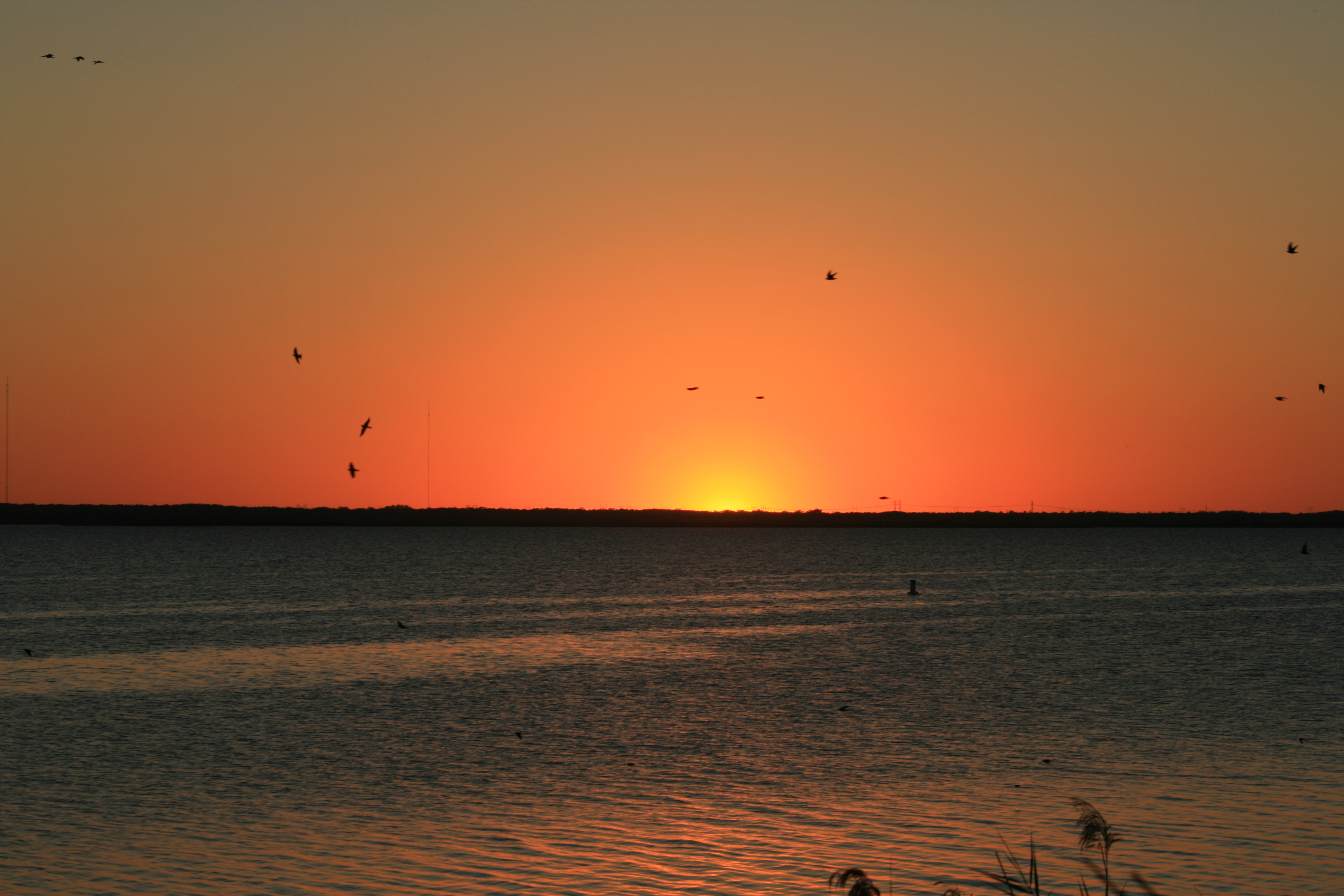
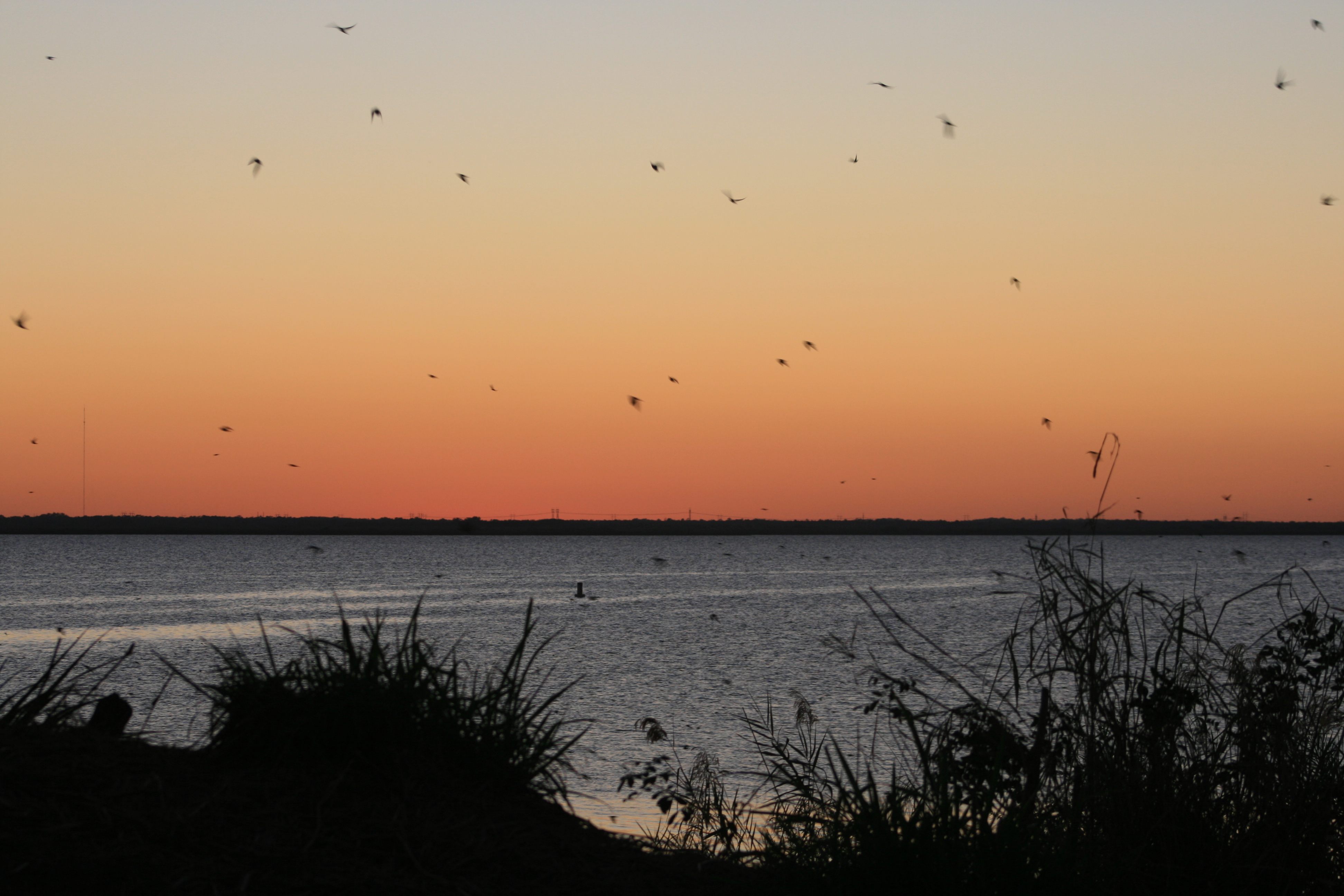
Image of a tree swallow up close (from
Wikipedia).
References:
Martin, W. J., and A. Shapiro, 2007: Discrimination of Bird and
Insect
Radar Echoes in Clear Air Using
High-Resolution Radars. J. Atmos.
Oceanic Technol., 24,
1215-1230.
Wilson, J. W., T. M. Weckwerth, J. Vivekanandan, R. M.Wakimoto, and
R.
W. Russell, 1994: Boundary layer clear-air
radar echoes: Origin of echoes and accuracy of derived winds.
J. Atmos. Oceanic Technol.,
11, 1184–1206.