Absorption is the process by which
radiant energy is absorbed and converted into other forms of energy. Absorption occurs when
incident energy of the same frequency as the resonant frequency of an atom or molecule is
absorbed, producing an exited state. The energy is transformed into heat motion and is
subsequently reradiated at a longer wavelength. Absorption and scattering are frequently
combined into a term known as an extinction coefficient. Certain wavelengths of
radiation are affected far more by absorption than by scattering: infrared wavelengths and
wavelengths shorter than the visible portion of the electromagnetic (EM) spectrum. Absorption
can occur due to atmospheric gases, aerosols, clouds and precipitation particles. Atmospheric
gases like water vapor, oxygen, nitrous oxide, carbon dioxide and ozone are the most common
absorbers of incident radiation. In a clear atmosphere, gas molecules such as carbon dioxide
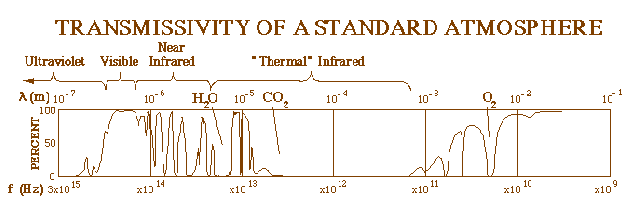
absorb radiation in selective wavelength bands creating a complicated pattern of atmospheric
absorption bands shown below. An absorption band is defined as range of wavelengths in
the EM spectrum within which radiation is absorbed by a substance.
The vertical axis of the figure above is the percentage of transmission through a standard vertical path length through the atmosphere. Note one of the largest atmospheric windows resides in the visible portion of the spectrum. An atmospheric window is a portion of the EM spectrum that effectively transmits radiant energy. There are other windows within the near infrared and thermal infrared regions. Satellite observations of surface features are limited to sensors operating in these window regions. However, the atmosphere itself is also of interest and so radiometers have also been chosen to detect radiation along the edges of atmospheric windows where the atmosphere becomes more opaque due to the presence of a particular gas.
This sounding process is governed by the following concept of radiative transfer: the radiation emitted
by the Earth’s atmosphere at a particular frequency results from contributions along the line of view from the
satellite instrument. Radiation upwelling from the lower levels of the atmosphere is typically partially
absorbed at higher levels and re-emitted in proportion to the absorption. If there is a
temperature difference between two levels in the atmosphere, especially between higher
and lower levels in the atmosphere, the radiation will be reduced or increased as a function of the
temperature difference. The quantity known as spectral radiance is defined as the radiant energy flowing
through a unit area in a given direction per unit time per unit of frequency per unit of solid angle. Spectral
radiance is thus the sum of the contributions along the viewing path, given by the expression
R = R(0)t(0) + B(t/x) dx,
in which B is the radiance of a blackbody (Planck radiance) at the atmospheric
temperature, t is the transmittance of the atmosphere, and x is a variable which represents distance or
pressure. The term R(0)t(0) is the contribution in radiance by the Earth’s surface
if the transmittance is nonzero. This equation states that the radiance observed from a satellite sounder is a
weighted mean of the blackbody radiances B in which the weight is given by t/x, known as
the transmittance weighting function. The transmittance weighting
function indicates the sensitivity of each channel to
atmospheric height or pressure level and thus the vertical resolution of the sounding data.
For a more detailed explanation of the transmittance weighting function, click here .
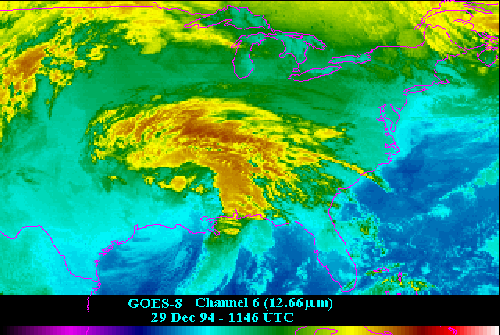
For example, an instrument sensitive to radiation whose wavelength is close to a window is able to "see" through most of the atmosphere and detect radiation being emitted from near the surface as shown below.
 The 12.66 µ m channel is
located fairly close to a window region such that surface features are visible
(e.g., the Great Lakes or the Gulf Stream) even though there is still some sensitivity to
atmospheric moisture.
The 12.66 µ m channel is
located fairly close to a window region such that surface features are visible
(e.g., the Great Lakes or the Gulf Stream) even though there is still some sensitivity to
atmospheric moisture.
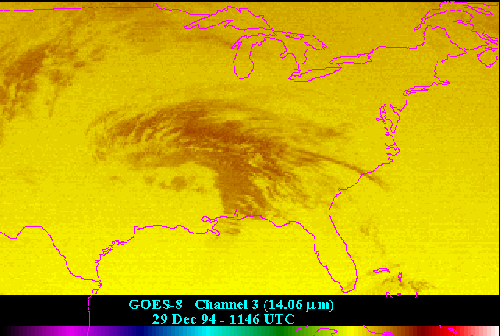
However, the
image on the left is located closer to an absorption band and will
only detect radiation from the higher levels in the atmosphere. All radiation coming from
surface and lower level clouds is absorbed by carbon dioxide in this 14.06 µ m channel.
The image takes on a foggy appearance with only high clouds visible.
The two images above
are color enhanced to emphasize maximum contrast across all temperature ranges. The left side
of the colorbar on the bottom of each picture indicates warm temperatures (50 º C) while
the right side indicates cold temperatures (-100 º C). If you are unfamiliar with the
concepts of enhancing satellite imagery, go to the section on
enhancements.