More on Transmittance Weighting functions
The transmittance weighting function represents the rate of change of transmittance
with respect to height in the atmosphere (pressure level).
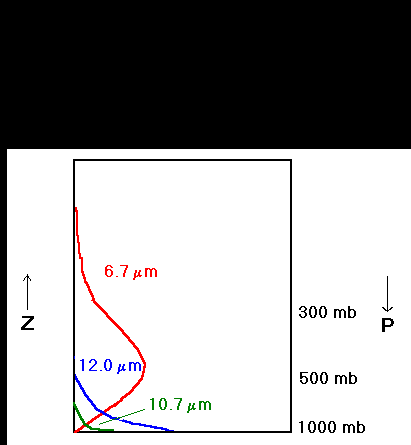 This figure is an example of transmittance weighting
functions plotted for three sounding frequencies as a function of height (z) and pressure level (p).
Transmittance weighting functions have a vertically localized distribution about some specific level in the
atmosphere which can be determined by designing a sensing instrument which will measure upwelling
radiance in the close proximity of a particular frequency. The correspondence between frequency at which a
satellite sensor measures radiance and the atmospheric level at which the Planck function profile is maximally
weighted is at the core of techniques for vertically sounding the atmosphere using upwelling radiation data.
By choosing a set of frequencies at which radiance would be measured, a set of atmospheric levels at which
the Planck function will have maximum impact on the radiance values is established.
Differentiating the transmittance weighting function with respect to height (pressure) will
yield the height in the atmosphere or the pressure level for which the weighting function
achieves a maximum value. Since atmospheric transmittance does not increase uniformly with
altitude, but increases in a non-linear fashion, its vertical derivitave (increase with
decreasing atmospheric pressure or increasing altitude) achieves a maximum value at some
pressure level. At this level the slope of the transmittance profile achieves a maximum value.
This figure is an example of transmittance weighting
functions plotted for three sounding frequencies as a function of height (z) and pressure level (p).
Transmittance weighting functions have a vertically localized distribution about some specific level in the
atmosphere which can be determined by designing a sensing instrument which will measure upwelling
radiance in the close proximity of a particular frequency. The correspondence between frequency at which a
satellite sensor measures radiance and the atmospheric level at which the Planck function profile is maximally
weighted is at the core of techniques for vertically sounding the atmosphere using upwelling radiation data.
By choosing a set of frequencies at which radiance would be measured, a set of atmospheric levels at which
the Planck function will have maximum impact on the radiance values is established.
Differentiating the transmittance weighting function with respect to height (pressure) will
yield the height in the atmosphere or the pressure level for which the weighting function
achieves a maximum value. Since atmospheric transmittance does not increase uniformly with
altitude, but increases in a non-linear fashion, its vertical derivitave (increase with
decreasing atmospheric pressure or increasing altitude) achieves a maximum value at some
pressure level. At this level the slope of the transmittance profile achieves a maximum value.
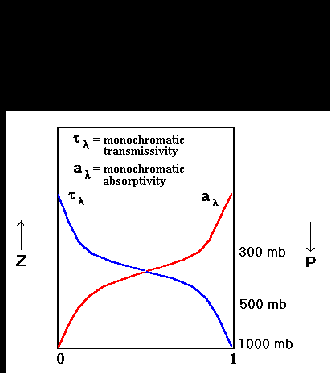 This figure is a display of transmittance and absorptance curves plotted at a
function of height (z) and pressure level (p). Frequencies for which the weighting function peaks at
a high altitude in the atmosphere will have transmittance values that are small or
zero at the earth’s surface. As a result, a satellite sensor would receive most of its
radiation from high atmospheric altitudes. In highly transparent atmospheric windows, the
weighting function peak will be located at or near the Earth’s surface and a satellite sensor
would receive most of its radiation from the surface contribution term (R(0)T(0)) since the
surface transmittance value is high. For frequencies between these extremes, there would be a
combination of surface and atmospheric contribution to the upwelling radiance received by a
satellite sensor. This demonstrates that sampling atmospheric properties at
particular altitudes involves making electromagnetic radiation measurements at particular
frequencies. It is important to note that a set of sounding frequencies should be selected
along the edge of an absorption band where an absorbing gas becomes increasingly more
opaque. An absorption band is a range of frequencies in the electromagnetic spectrum within
which radiation is absorbed by a substance.
This figure is a display of transmittance and absorptance curves plotted at a
function of height (z) and pressure level (p). Frequencies for which the weighting function peaks at
a high altitude in the atmosphere will have transmittance values that are small or
zero at the earth’s surface. As a result, a satellite sensor would receive most of its
radiation from high atmospheric altitudes. In highly transparent atmospheric windows, the
weighting function peak will be located at or near the Earth’s surface and a satellite sensor
would receive most of its radiation from the surface contribution term (R(0)T(0)) since the
surface transmittance value is high. For frequencies between these extremes, there would be a
combination of surface and atmospheric contribution to the upwelling radiance received by a
satellite sensor. This demonstrates that sampling atmospheric properties at
particular altitudes involves making electromagnetic radiation measurements at particular
frequencies. It is important to note that a set of sounding frequencies should be selected
along the edge of an absorption band where an absorbing gas becomes increasingly more
opaque. An absorption band is a range of frequencies in the electromagnetic spectrum within
which radiation is absorbed by a substance.
Go back one step
Go to front page