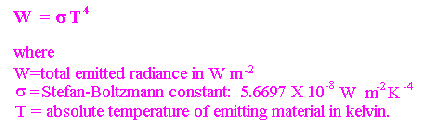
Emission is defined as the electromagnetic radiation exiting an object due to the random motion and collision of molecular matter within the object. All objects whose temperatures are greater than absolute zero emit radiation. But the intensity of radiation changes according to the objects temperature. This property can be determined by considering the Stefan-Boltzmann Law:
Note that the radiant energy emitted from an object is proportional to the fourth power of the temperature. Therefore, a linear increase in an object's temperature results in an exponential increase in radiant energy. The total radiant energy expressed in the Stefan-Boltzmann Law also assumes the object is radiating as a blackbody. How close an object can approach an ideal blackbody is related to the object's emissivity.
For any radiating object, the intensity of radiation changes as a function of wavelength. This can be illustrated with the figure below which shows an emission spectrum for the Sun and the Earth for typical temperatures. Note that the intensity curve has the appearance of a skewed bell curve for both bodies. The total radiant exitance or W can be calculated by integrating the total area under the curve.
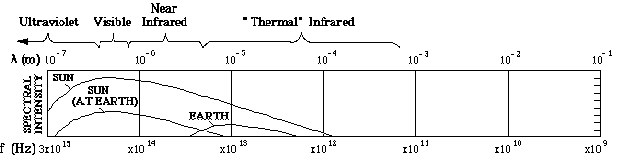
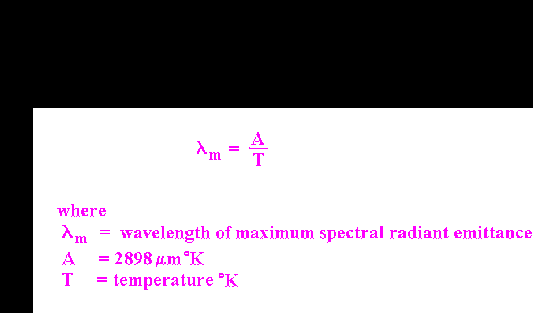
Not only does the intensity of the radiation change with changing temperature but the spectral distribution of that energy also changes. In other words, the wavelength of peak spectral exitance shifts to longer wavelengths with decreasing temperatures. With temperatures of 6000 º K, the wavelength of peak intensity is around 0.5 µ m but as temperatures fall to values typical of the Earth's surface (290 º K), the wavelength increases to about 10 µ m. This relationship between peak spectral intensity and blackbody temperature is described by Wien's Displacement Law. Wien's Displacement Law states that
Now if the distance between the Earth, Sun and satellite were equal, the solar radiation would overpower the terrestial radiation for every wavelength. All infrared channels would have solar contamination during the day. Fortunately, that's not the case. The intensity of solar radiation decreases proportionally to the square of the distance the satellite is from the sun. By the time the solar radiation gets to the Earth, it is weak enough to be almost negligible compared to radiant emissions from Earth in the thermal infrared regions. So during the day, there is almost no reflected solar infrared contribution to the radiation emitted from the Earth. That is why the satellite observed brightness temperatures don't change from day to night. Solar contributions to Earth emitted thermal infrared radiation really become negligible beyond 4.0 µ m. In the area from about 3 to 4 µ m, both reflected solar and emitted Earth radiation arrive at the satellite in comparable amounts. And under 3 µ m, there is almost no emitted radiation from the Earth as indicated by Wien's Displacement Law.
Here are some subjective comparisons of emitted energy in shortwave (3 to 4 µ m) and longwave (10 to 12 µ m) channels.
|
Table 1. Radiant emittance vs. wavelength | |||
| Surface | Radiant emittance | ||
|---|---|---|---|
| Vis | Shortwave IR | Longwave IR | |
| Snow | none | low | low |
| Ice | none | low | low |
| Lake | none | medium | medium |
| Land Surface | none | high | medium |
| Water Cloud | none | medium | medium |
| Ice Cloud | none | low | low |
| Dust | none | medium | medium |