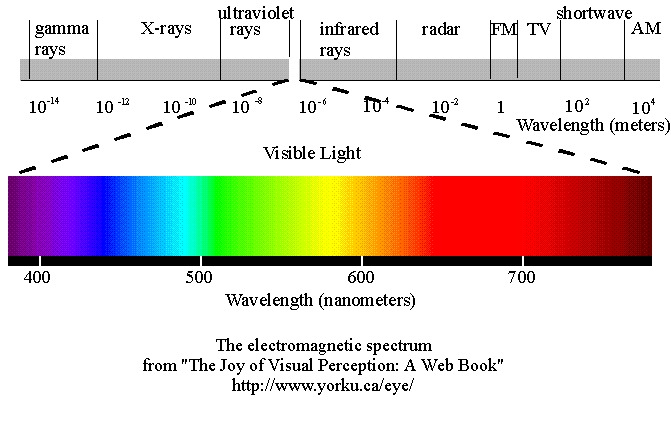
Satellite sensors detect electromagnetic energy and thus, acquire data on the way various earth features emit and reflect electromagnetic energy. Energy radiates in accordance with basic wave theory: electromagnetic energy travels in harmonic, sinusoidal manner at the speed of light, (c). The distance from one wave peak to the next is the wavelength and the number of peaks passing a fixed point in space per unit time is the wave frequency (v). Waves obey the general equation c= vL. Since the speed of light is essentially constant, frequency and wavelength are inversely related.
Divisions in the spectrum have grown out of the various methods for sensing each type of radiation:
Remote sensing systems operate in one of several of the visible, infrared, or microwave portions of the electromagnetic spectrum. In the visible portion, features are observed by virtue of reflected solar energy. By contrast, in the infrared portion, sensing of emitted energy predominates. The dividing line between sensing reflected and emitted radiation is the wavelength of approximately 3 µm.
Remote sensing data acquisition of surface features is limited to the nonblocked spectral regions of the electromagnetic spectrum referred to as atmospheric windows. Atmospheric windows define wavelength ranges in which the atmosphere is particularly transmissive of energy. The visible region of the electromagnetic spectrum resides within an atmospheric window in the wavelength range of about 0.3 to 0.9 µm while emitted energy from the earth's surface is sensed through windows at 3 to 5 µm and 8 to 14 µm. Radar and passive microwave systems operate through a window region of 1 mm to 1 m.
In contrast, in opaque regions of the electromagnetic spectrum that are highly absorptive, terrestrial radiation would be absorbed and re-emitted at higher levels in the atmosphere. Therefore, a satellite sensor would receive most of its radiation from higher atmospheric altitudes and would thus obtain more temperature information from higher levels in the atmosphere.
It is important to note and understand the interaction and the interdependence between the primary sources of electromagnetic energy, the atmospheric windows through which source energy may be transmitted to and from the earth's surface, and the spectral sensitivity of the sensors available to detect and record the energy.
| Channel | Spectral Bandwidth (µm) | |
|---|---|---|
| 1 | 0.52-0.72 (visible) | |
| 2 | 3.78-4.03 (infrared) | |
| 3 | 6.47-7.02 (water vapor) | |
| 4 | 10.2-11.2 (infrared) | |
| 5 | 11.5-12.5 (infrared) |
| Channel | Spectral Bandwidth (µm) | |
|---|---|---|
| 1 | 0.53-0.77 (visible) | |
| 2 | 3.76-4.03 (infrared) | |
| 3 | 5.77-7.33 (water vapor) | |
| 4 | 10.23-11.24 (infrared) | |
| - | ||
| 6 | 12.96-13.72 (infrared) |
| Channel | Spectral Bandwidth (µm) | |
|---|---|---|
| 1 | 0.58-0.68 (visible) | |
| 2 | 0.725-1.10 (near infrared) | |
| 3a | 1.58-1.64 (infrared) | |
| 3b | 3.55-3.93 (infrared) | |
| 4 | 10.30-11.30 (infrared) | |
| 5 | 11.50-12.50 (infrared) |
| Channel | Spectral Bandwidth (µm) | |
|---|---|---|
| 1 | 0.45-0.52 (visible) | |
| 2 | 0.52-0.60 (visible) | |
| 3 | 0.63-0.69 (visible) | |
| 4 | 0.76-0.90 (near infrared) | |
| 5 | 1.55-1.75 (infrared) | |
| 6 | 10.4-12.5 (infrared) | |
| 7 | 2.08-2.35 (infrared) |